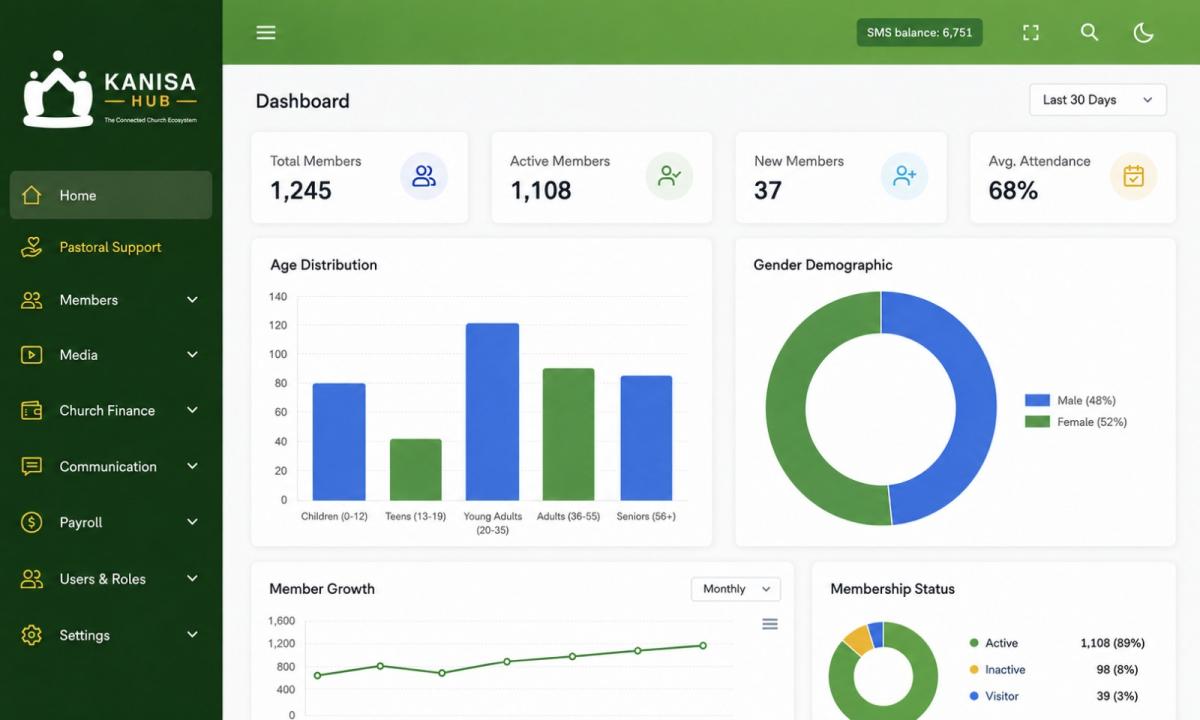
What Is a Church Management System?
A Church Management System, often shortened to ChMS, is software designed specifically for church administration and ministry engagement. It provides one organized place for managing people, communication, attendance, groups, events, pastoral care, giving records and ministry information.
Unlike general business software, a well-designed ChMS reflects how churches actually operate: members belong to families, ministries and groups; visitors require intentional follow-up; pastors handle sensitive prayer and care requests; and church communication must reach different audiences at the right time.
A complete church management platform commonly supports:
Member and household records
Visitor capture and follow-up
Attendance and participation tracking
Groups, departments and ministry coordination
Announcements, push notifications and Bulk SMS
Prayer requests and pastoral appointments
Giving and pledge records
Services, events and ministry planning
Sermons, devotionals and other church media
Reports and leadership insights
Why Churches in Kenya Are Going Digital
Kenyan churches serve congregations that are increasingly mobile and digitally connected. Members expect timely updates, accessible church information and convenient ways to engage beyond the Sunday service. Leaders need dependable systems that can support ministry growth without creating an equally large administrative burden.
Digital church management helps a church create continuity. When a ministry leader changes, information does not disappear with a notebook or personal phone. When a visitor returns, the church can recognize the relationship. When a member requests prayer or an appointment, the pastoral team can respond through an organized process.
For local churches, the strongest platforms also recognize practical realities such as mobile-first access, M-Pesa-based giving records, Bulk SMS communication and responsive local support.
Essential Features of Church Management Software
Member and Household Management
Healthy ministry begins with knowing people well. Centralized member profiles help churches maintain accurate contact details, family relationships, ministry involvement, group membership and relevant pastoral information. Authorized leaders can find the information they need without relying on scattered spreadsheets.
Visitor Follow-Up
A visitor should not become an anonymous attendance number. A structured visitor process helps the church capture appropriate details, record visits, assign follow-up and support the journey from first-time guest to connected member.
Attendance and Engagement
Attendance data becomes valuable when it helps leaders notice patterns. Beyond counting a congregation, digital attendance can reveal consistent participation, changing engagement and people who may need thoughtful follow-up. Attendance should support pastoral awareness— not reduce people to statistics.
Communication
Church communication often crosses announcements, ministry teams, events and urgent updates. A centralized platform helps leaders communicate to the right people through channels such as in-app notifications, push notifications and Bulk SMS, while reducing dependence on numerous disconnected groups.
Pastoral Care
Prayer requests, testimonies, counselling needs and pastoral appointments require care, discretion and reliable follow-through. Organizing these activities within a role-controlled pastoral workflow helps leaders respond more intentionally while limiting access to authorized people.
Groups, Departments and Discipleship
Church life happens in ministries, home cells, departments, classes and discipleship groups. A ChMS should help leaders organize these communities, understand participation and coordinate the people responsible for them.
Giving and Pledge Records
Digital records help churches organize tithes, offerings, pledges and designated contributions more accurately. In Kenya, this may include recording M-Pesa contributions and improving reconciliation and reporting. The exact payment and accounting workflow should match the church’s approved financial controls.
Services, Events and Ministry Planning
Churches coordinate services, conferences, outreach activities, training, fundraising and ministry meetings. Connected planning tools improve visibility, registration, team coordination and communication before and after each activity.
Media and Ongoing Engagement
Ministry continues after a service ends. Making sermons, devotionals, books and church updates available through a mobile experience helps members remain connected to teaching and spiritual growth throughout the week.
Reports and Leadership Insight
Leaders need more than raw lists. Clear reports can help them understand membership growth, attendance patterns, giving records, ministry participation and engagement. Better visibility supports better questions, planning and pastoral decisions.
Why Mobile-First Church Management Matters
Many church management systems are designed primarily for an administrator seated at a desktop. That approach overlooks how ministry actually happens. Pastors visit people, leaders coordinate teams from different locations, and members interact with the church through their phones.
A mobile-first platform connects administration and engagement:
Pastors and authorized leaders can respond to ministry needs away from the office.
Members can receive announcements and access church content throughout the week.
Ministry teams can stay informed about events, services and responsibilities.
Prayer, appointments and engagement can follow an organized digital journey.
The church can provide one consistent experience instead of several disconnected tools.

What to Look for When Choosing a Church Management System
The best platform is not simply the one with the longest feature list. Churches should evaluate whether the system fits their ministry, people and operating environment.
Ministry fit: Does it support the church’s actual pastoral, discipleship and administrative workflows?
Ease of use: Can pastors, administrators, ministry leaders and members use it confidently?
Mobile experience: Does it provide meaningful mobile access rather than only a desktop dashboard?
Access controls: Can sensitive information be limited to the right roles?
Communication options: Does it support practical channels used by the congregation?
Local relevance: Does it understand Kenyan payment, communication and support realities?
Scalability: Can the church add members, ministries and functionality without rebuilding its records?
Implementation support: Is assistance available for data preparation, onboarding and training?
Why Churches Choose Kanisa Hub?
Kanisa Hub is a mobile-first church management and engagement platform built for African churches. It connects the administrative work of church leaders with the everyday experience of members, helping ministry continue beyond the office and the Sunday service.
Church leaders can organize members and families, attendance, groups, departments, pastoral care, communication, events, giving records and ministry information. Members can stay connected through the Kanisa Hub mobile experience, including announcements, events, prayer engagement, pastoral appointments, sermons and other church content.
Kanisa Hub brings together:
Members, families and visitor records
Attendance and ministry participation
Groups, departments and home cells
Announcements, push notifications and Bulk SMS
Prayer requests, testimonies and pastoral appointments
Giving and pledge records
Services, projects and events
Sermons, devotionals, books and church media
Role-based dashboards, reports and leadership visibility
Built for African ministry realities
Kanisa Hub combines local relevance, a member-facing mobile experience and ministry-centered workflows in one connected platform—supported by a team that understands churches in Kenya.
Frequently Asked Questions
Is a church management system suitable for a small church?
Yes. Smaller churches benefit from accurate member records, consistent communication and organized follow-up. Starting with a good structure also makes future growth easier to manage.
Can members use Kanisa Hub on their phones?
Yes. Kanisa Hub includes a mobile experience designed to keep members connected to church announcements, events, ministry content, prayer and other relevant activities.
Can a church use M-Pesa information in its giving records?
Churches can organize digital giving records, including contributions received through channels such as M-Pesa. The available payment automation and reconciliation setup should be confirmed during implementation.
How does Kanisa Hub handle sensitive pastoral information?
KANISA HUB | INSIGHTS Access is controlled according to authorized roles. Pastoral workflows and sensitive information should only be available to the leaders entrusted with them.
Can church leaders manage ministries and departments?
Yes. Kanisa Hub supports the organization of groups, departments, ministry teams and related member participation.
Will church staff receive training?
Implementation should include guided setup, data preparation and training so the church can adopt the platform confidently.
Final Thoughts
Technology should never become the centre of church life. Its purpose is to remove friction, preserve important information and help leaders care for people more consistently. A well-chosen church management system gives leaders a clearer view of the congregation, strengthens communication and creates more dependable ministry processes. For churches in Kenya, the right solution should also be mobile-first, locally relevant and designed around ministry rather than adapted from generic business software.
Ready to Simplify Your Church Administration?
Kanisa Hub helps churches manage people, communication, attendance, pastoral care, groups, events, giving records and ministry engagement from one connected platform.
Book a free demonstration to see how Kanisa Hub can support your church.
eric
Aug 12, 2026
Interesting discussion